
From Plastic Waste to Building Materials: The Inspiring Innovation of Nzambi Matee
- Dr Kevin Ho
- May 26
- 3 min read
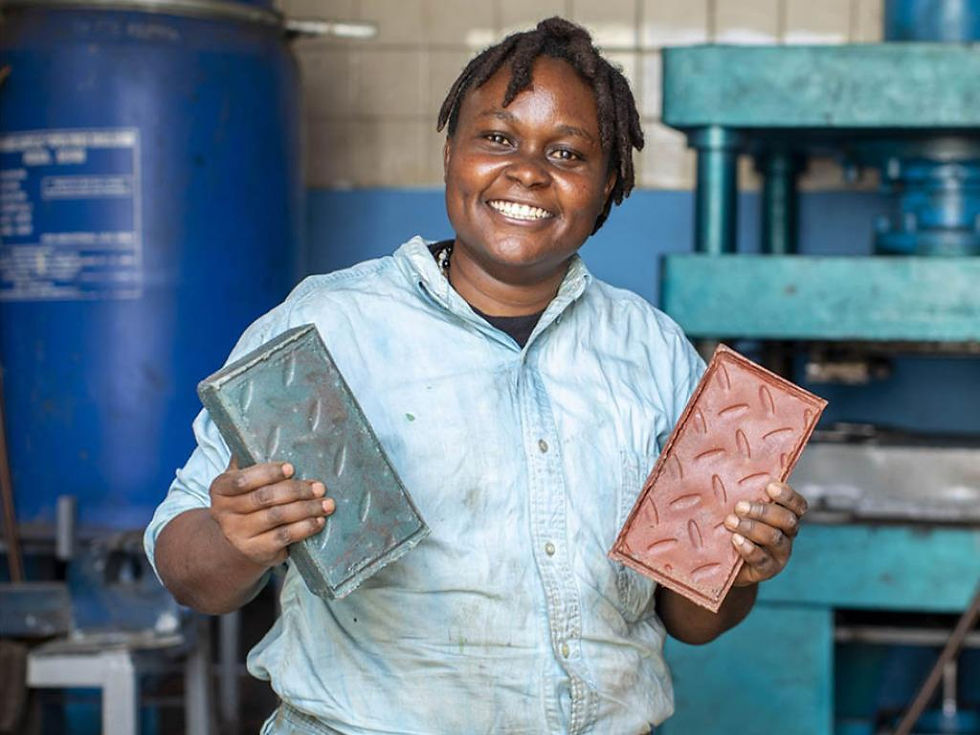
In a world struggling with mounting plastic pollution, one Kenyan engineer has shown that waste does not always have to remain waste.
Nzambi Matee, a mechanical engineer and entrepreneur from Nairobi, Kenya, has gained international recognition for transforming discarded plastic waste into durable paving bricks through her company, Gjenge Makers.
Her story is more than just a sustainability success story. It is a reminder that innovation often begins when people start looking at old problems from a completely different perspective.
Rethinking Plastic Waste
Plastic pollution has become one of the most visible environmental challenges of our time. Across the world, millions of tonnes of plastic waste end up in landfills, rivers, and oceans every year. Many forms of plastic are difficult or uneconomical to recycle using traditional methods.
Rather than viewing this waste purely as a disposal problem, Nzambi Matee asked a different question:
What if plastic waste could become a construction resource?
That simple shift in perspective became the foundation of an innovative circular economy business model.
How the Process Works
The process used by Gjenge Makers involves collecting certain types of waste plastics such as:
High-density polyethylene (HDPE)
Low-density polyethylene (LDPE)
Polypropylene (PP)
These plastics are commonly found in:
shampoo bottles,
detergent containers,
bottle caps,
packaging materials,
and plastic bags.
The collected plastics are cleaned, shredded into small flakes, and mixed with sand in carefully controlled ratios.
The mixture is then heated until the plastic softens and melts, allowing it to act as a binding material around the sand particles. The hot material is compressed into molds to form paving blocks and bricks. Once cooled, the plastic solidifies and locks the material together into a strong composite product.
In simple terms:
the sand acts as the structural filler,
while the melted plastic acts as the binder.
This creates a durable composite material that can be used for paving and non-structural construction applications.
Is the Idea Completely New?
Using plastic in construction materials is not entirely new. Around the world, researchers and entrepreneurs have experimented with:
eco-bricks made from plastic bottles,
plastic-enhanced asphalt roads,
recycled plastic panels,
and plastic-sand composite materials.
What makes Nzambi Matee’s work stand out is not simply the idea itself, but the successful combination of:
practical engineering,
scalable manufacturing,
waste reduction,
commercial viability,
and social impact.
In many cases, sustainability breakthroughs are not about inventing something entirely from scratch. They are about improving, adapting, and scaling ideas in ways that make them economically practical and socially meaningful.
Why This Matters for ESG and Sustainability
The story of Nzambi Matee strongly reflects several important ESG and sustainability principles.
Circular Economy
Waste materials are reintroduced into the economy as useful products instead of being discarded.
Environmental Impact
Plastic waste is diverted away from landfills and waterways.
Economic Opportunity
New industries and employment opportunities can emerge from waste valorization.
Sustainable Innovation
The solution demonstrates how environmental challenges can inspire commercially viable innovation.
Localized Solutions
The approach utilizes locally available waste streams and addresses local infrastructure needs.
This is an important lesson for businesses everywhere:
Sustainability is no longer just about compliance or reporting. It is increasingly about innovation, efficiency, and finding value in areas previously overlooked.
Challenges and Considerations
While the innovation is promising, plastic-based construction materials also raise important technical and environmental questions.
Some of the key considerations include:
long-term durability,
heat resistance,
fire performance,
UV degradation,
and potential microplastic release over time.
Because of these factors, such materials are commonly used in:
paving blocks,
walkways,
landscaping,
and other non-structural applications.
As with any emerging material technology, proper testing, standards, and lifecycle assessment remain important.
A Bigger Lesson for the Future
Perhaps the most powerful aspect of Nzambi Matee’s story is what it represents.
It demonstrates that sustainability innovation does not only come from massive multinational corporations or billion-dollar research laboratories. Sometimes, meaningful change begins with someone willing to challenge conventional thinking and see opportunity where others only see waste.
In a rapidly changing world facing climate change, pollution, and resource constraints, the future may belong to those who can successfully turn environmental problems into practical economic solutions.
And sometimes, even a pile of discarded plastic can become the foundation for building something better. One man's trash is another woman's building block.


Comments